
Research shows traders keeping systematic journals achieve results 30-40% better than those who don't. We show what to document and how to do it effectively.
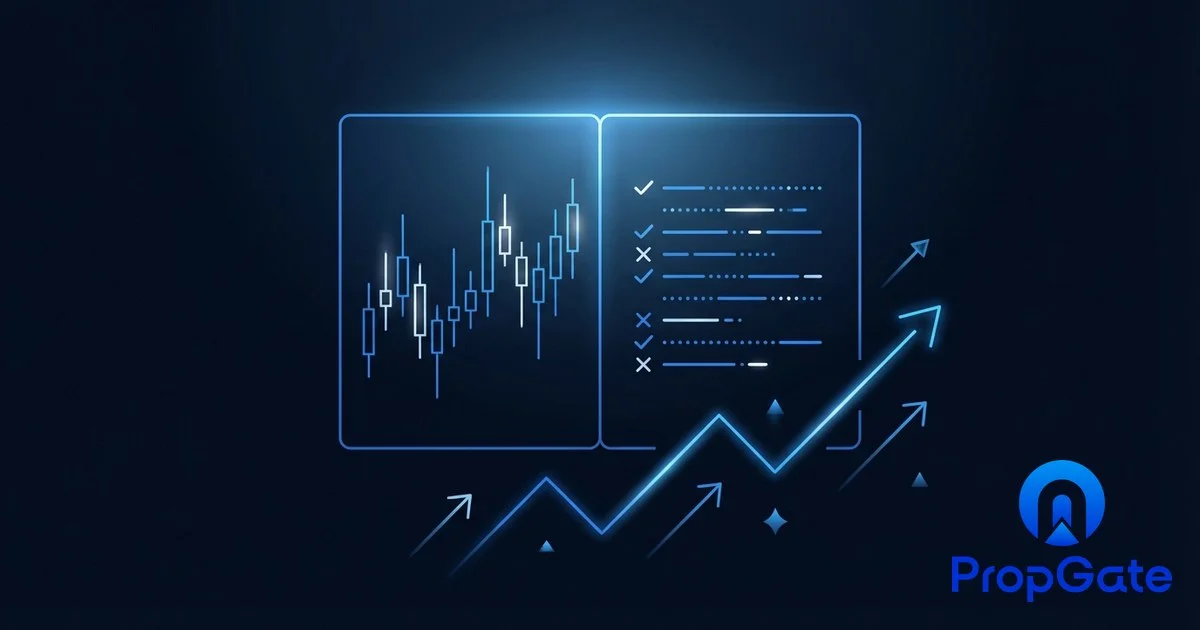
Research conducted on a group of over 500 forex traders found that those keeping a regular, detailed trade journal achieved results 31-43% better over a 12-month observation window compared to a group without journals. The difference stemmed not from "writing magic," but from systematic identification and correction of errors.
On a prop trading account, this difference has direct financial implications: a trader with a 100K account earning 6%/month without a journal vs. 8%/month with one is a difference of $2,400 monthly. Over a year: $28,800.
A trading journal isn't a MetaTrader screenshot. It's structured documentation of every trading decision containing:
Objective data (what?):
Subjective data (why?):
Outcome data (what did I learn?):
Recording alone isn't enough. Weekly journal analysis should answer specific questions:
Setup questions:
Risk questions:
Psychology questions:
Simple spreadsheets (Google Sheets/Excel) Free, fully configurable. Require manual data entry. Good start for a trader building the habit.
TraderVue Automatic trade history import from brokers (MT4/MT5, cTrader). Visual analytics, R:R tracking, setup tagging. Cost: approx. $29-$49/month.
Edgewonk Advanced psychological and statistical analysis. Particularly good for traders wanting deeper behavioral pattern analysis. Cost: one-time approx. $169-$229.
Myfxbook MT4/MT5 integration via Expert Advisor. Automatic reports, public statistics. Free, but less feature-rich than TraderVue.
If you're starting out and want the simplest possible solution:
| Date | Instrument | Result (USD) | Setup | Followed Plan? |
|---|---|---|---|---|
| 03/03/2026 | EURUSD | +120 | MA cross | Yes |
| 03/03/2026 | GBPUSD | -80 | Breakout | No (increased lot) |
Even this simplified format allows you to see patterns after a month that you won't notice intuitively.
If a prop account is managed by an external team (like PropGate), the trade journal is maintained on the manager's side. The client has access to trade reports and account history, but doesn't need to independently document and analyze each decision.
This is one of the hidden benefits of the managed model: systematic data analysis is built into the process, not an optional tool that can be ignored during moments of fatigue or pressure.
Learn how prop trading works or let us handle the challenge for you.