
Most traders lose funded accounts not from bad trades, but from misunderstanding the difference between daily and maximum drawdown. We break down the mechanics with real numbers.
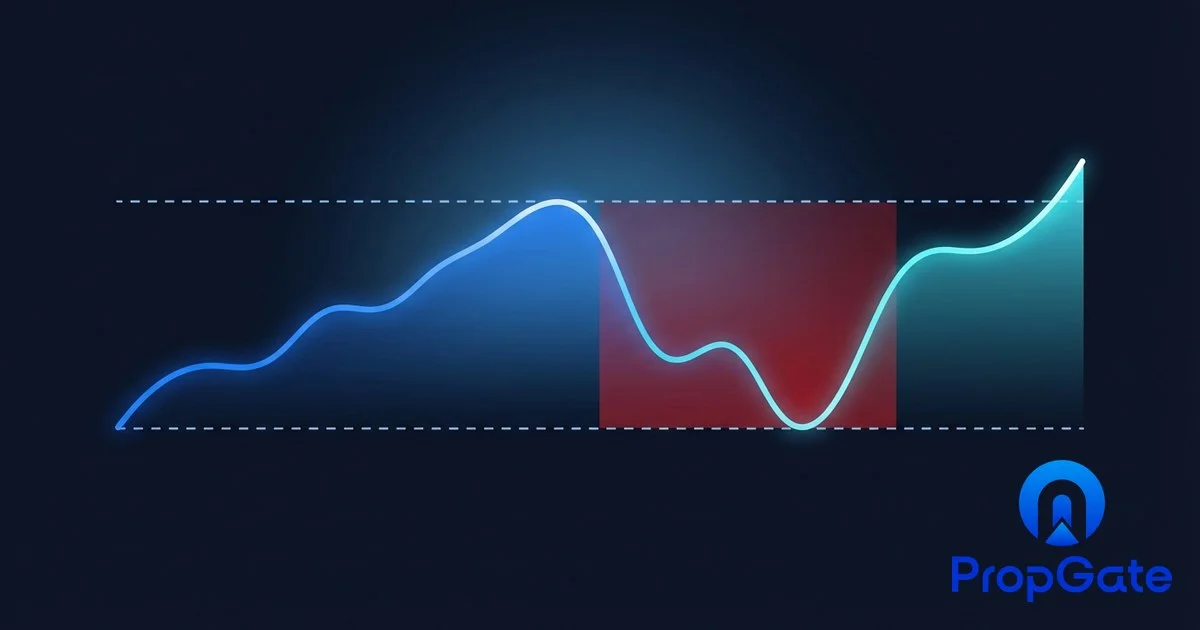
The terms "daily drawdown" and "maximum drawdown" sound straightforward. In practice, their consequences are subtle and vary between prop firms. Misunderstanding these rules is one of the most common reasons experienced traders lose funded accounts.
Daily drawdown is the maximum permitted loss calculated within a single trading session. Most firms set this limit at 4-5% of account value.
Example for a $100,000 account with a 5% limit:
Critical detail: many firms calculate daily drawdown from equity (account value including open positions), not from balance (closed trade results). This means unrealized losses count toward the limit immediately, not only after closing positions.
This is where significant differences between firms begin. Two main mechanisms exist:
The limit calculated from the initial account value. A $100,000 account with 10% max drawdown means the absolute loss level is $90,000.
If you earn $5,000 and have $105,000 in the account, your max drawdown still refers to $90,000. You can lose a maximum of $15,000 from the current balance before violating the limit.
A mechanism used by some firms that moves with equity. The drawdown limit follows the maximum achieved account balance.
Example: $100,000 account with 10% trailing drawdown:
Why this is dangerous: a trader who earned 8% and thinks they have a "cushion" may be surprised to find trailing drawdown has radically narrowed their available margin.
Take a $100,000 account at FTMO (static max drawdown 10%, daily drawdown 5%):
| Scenario | End-of-day Equity | Available Daily Drawdown | Total Buffer |
|---|---|---|---|
| Start | $100,000 | $5,000 | $10,000 |
| After +3% profit | $103,000 | $5,150 | $13,000 |
| After -3% loss | $97,000 | $4,850 | $7,000 |
With trailing drawdown, the same table looks different - the total buffer never grows relative to maximum equity.
1. Overnight positions with high risk Leaving large positions overnight exposes the account to opening gaps. Many firms calculate equity 24/7 - even during weekends if a position is open.
2. Position correlation Opening 3 long positions on EURUSD, GBPUSD, and AUDUSD looks like diversification, but it's effectively triple USD exposure. One Fed decision and all 3 positions lose simultaneously.
3. Ignoring unrealized losses Many traders only look at balance (closed trade results), ignoring equity (including open positions). The firm calculates drawdown from equity - a trader can violate the limit without closing a single trade.
Personal daily limit below the required limit: Set a personal alarm at 50-60% of the firm's daily limit. If the firm requires 5%, your alarm sounds at 2.5-3%.
Exposure calculator: Before opening another position, check total open position exposure. Quick test: if all open positions suddenly lose 50% of their stop-loss value, what's the total daily loss?
End session with margin: Never close a session with open positions consuming more than 60% of the daily buffer. Overnight news can change everything.
Understanding drawdown mechanics is one thing. Applying it consistently, day after day, under emotional pressure - that's entirely different. Experienced prop account managers build systems that protect against violations regardless of market mood. This systematic approach is exactly what separates professional account management from self-directed trading.
Learn how prop trading works or let us handle the challenge for you.
Explore PropGate